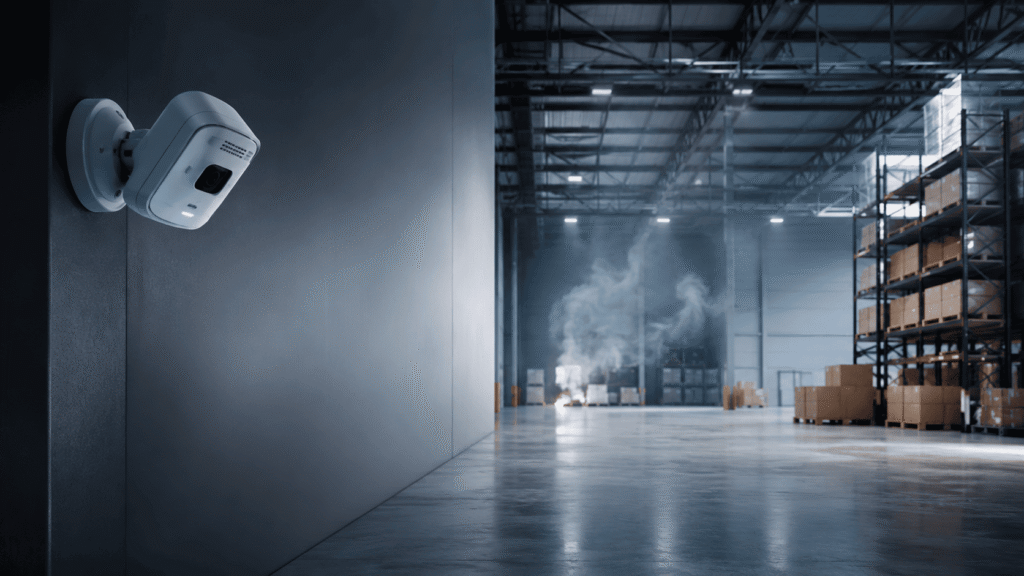
Smart fire detection systems represent a real shift in fire safety. With artificial intelligence and machine learning, fires can now be detected at their earliest stages, before they spread and become harder to control. Smart systems can detect smoke within only 30 seconds of formation, while traditional systems may take 6–8 minutes. This critical time difference can mean the difference between controlling the situation and facing a major incident.
In this article, we will explore how smart fire detection systems work, the technologies behind them, and the real benefits they provide for buildings and facilities in Saudi Arabia and the wider region.
- 01 - Introduction: Why Smart Systems Matter
- 02 - Traditional vs Smart Fire Detection Systems
- 03 - Core Technologies Behind Smart Detection
- 04 - Statistics and Numbers: The Impact of Early Detection
- 05 - Practical Applications of Smart Systems
- 06 - Additional Benefits of Smart Systems
- 07 - Challenges and Considerations
- 08 - Conclusion and Future Outlook
Introduction: Why Smart Systems Matter
In a world of rapid technological development, fire safety remains a real challenge for buildings and facilities around the world. According to statistics from the National Fire Protection Association (NFPA), annual losses caused by fires exceed 25 billion US dollars in the United States alone. Yet the bigger concern is not only the financial loss, but also the lives lost and the properties destroyed with every minute of delay in fire detection.
For decades, traditional fire detection systems have relied on the same basic principle: passive smoke detectors waiting for enough smoke to accumulate before triggering an alarm. This older approach carries an unavoidable delay that may reach 6–8 minutes from the start of the fire until the alarm is activated. In fire situations, every minute can separate early control from a major disaster.
Today, fire safety is seeing a major shift thanks to the use of artificial intelligence (AI), machine learning, and computer vision. These technologies allow smart systems to detect fires at very early stages, before they spread and grow.
Traditional vs Smart Fire Detection Systems
Traditional Systems: Limits and Challenges
Traditional detection systems rely on simple physical principles. A standard smoke detector contains a small chamber through which smoke passes. When enough smoke particles accumulate, they interrupt a light beam or affect a charged ion, which triggers the alarm. The problem is that this process needs time for enough smoke to build up, especially if the detector is far from the fire source.
Traditional systems also suffer from false alarms. Steam from hot showers, smoke from cooking, or dust in industrial facilities can trigger alarms even when there is no real fire. This leads to staff fatigue, loss of trust in the system, and in some cases, alarms may be ignored or systems may be disabled.
Smart Systems: A Major Step in Fire Safety
AI-powered smart systems work in a completely different way. Instead of passively waiting for smoke to accumulate, they use advanced cameras and sensors that operate continuously and actively. These systems analyze images and data in real time using deep learning models trained on thousands of fire and smoke images and videos across different environments.
What makes these systems valuable is their ability to distinguish real smoke from other visual events. When the system detects a smoke-like pattern, it analyzes the surrounding context. Is the temperature rising? Are flames visible? Is this happening in a cooking area? Through this advanced analysis, smart systems can greatly reduce false alarms.
Core Technologies Behind Smart Detection
Convolutional Neural Networks
At the center of smart fire detection systems is a technology known as Convolutional Neural Networks (CNN). These networks are inspired by the way the human brain processes visual information. They learn by analyzing millions of images and videos, extracting patterns and key features that indicate the presence of fire or smoke.
For example, a network may learn that orange, red, and yellow colors with fast movement often indicate flames. It may also learn that gray or white colors with gradual spreading may indicate smoke. More importantly, it can learn that white steam from a bathroom is not smoke, and brown dust in a factory is not necessarily a sign of fire.
Multi-sensor Fusion
Modern smart systems do not rely on one source of information. Instead, they collect and analyze data from multiple sensors together. These may include traditional smoke detectors, heat detectors, gas detectors, standard video cameras, and thermal or infrared cameras.
When smart systems combine data from all these sources, they gain a clearer picture of the situation. If the temperature is very high, the camera detects smoke, and the gas detector records an increase in carbon monoxide, the probability of a real fire becomes much higher. This integration significantly reduces the chance of false alarms.
Edge Computing
One of the important aspects of modern smart systems is that they process data locally on the device itself, instead of sending it to a remote cloud server. This is known as edge computing. The benefit of this approach is a major reduction in latency.
Instead of waiting for video to be sent to the cloud, processed, and then returned, analysis happens immediately on the device. This means detection can happen in less than a second from the earliest smoke formation. If the internet connection is interrupted, the smart system can continue operating reliably.
Statistics and Numbers: The Impact of Early Detection
Detection Speed
The difference in detection speed between traditional and smart systems is significant. Traditional systems may take an average of 6–8 minutes from the start of a fire until the alarm is activated. In contrast, AI-powered smart systems can detect smoke within only 30 seconds of formation. This means smart systems can be at least 5 minutes faster than traditional systems.
To understand why this matters, imagine a fire inside a warehouse. In the first minute, the fire may still be limited to a small corner. By the sixth minute, which is close to the traditional detection time, the fire may have spread to a much larger area. With smart detection, the fire can be identified around the 30-second mark, allowing faster action before the flames spread.
Damage Reduction
Data from respected research organizations such as the Fire Protection Research Foundation indicates that every minute of delay in fire detection can increase damage costs by 7–10%. This means an additional 5-minute delay, which may represent the difference between traditional and smart systems, can increase damage by 35–50%.
Even more interestingly, studies show that systems reducing response time by only two minutes may reduce damage by up to 50%. This means investing in smart fire detection systems is not only a safety decision, but also a financially sound decision.
Early Detection and Safe Evacuation
Data from NIST, the National Institute of Standards and Technology, indicates that alarms in general reduce fire reporting time by an average of 19.2 minutes. This additional time is critical for safe evacuation. With smart systems providing faster detection, facilities gain more time for organized and safer evacuation.
Practical Applications of Smart Systems
Warehouses and Factories
In large warehouses and factories, fires represent a major risk. Smart systems can monitor large areas with high efficiency. For example, one AI-powered camera can monitor several thousand square meters. With intelligent differentiation between real smoke, steam, and dust, false alarms are greatly reduced, improving operational efficiency.
Data Centers
Data centers contain highly sensitive and valuable equipment. Even a small fire in a data center can cause major financial losses. Smart systems provide very early detection, allowing quick intervention before equipment is affected.
Hospitals and Medical Facilities
In hospitals, fast and safe evacuation of patients is a top priority. Smart systems provide early warning that helps coordinate evacuation in a safe and organized way, especially for patients who need assistance.
Hotels and Resorts
In hotels, fire safety is extremely important because guests may not be familiar with emergency exits. Smart systems provide early detection and quick alerts that support safe and effective evacuation.
Additional Benefits of Smart Systems
Predictive Maintenance
Smart systems are not limited to detecting fires. They can also monitor the health of the system itself. If a detector battery is about to fail, or if there is a communication issue, an alert can be sent before failure occurs. This helps keep the system in proper working condition at all times.
Instant Visual Verification
When a smart system detects a possible fire, it can send an instant image or video of the location to the emergency team or firefighters. This allows them to prepare better before reaching the site.
Continuous 24/7 Monitoring
Smart systems provide continuous monitoring 24 hours a day, 7 days a week, without fatigue or distraction. Many major fires happen at night or during periods with no staff on site, and smart systems provide full protection during these times.
Integration with Building Management Systems
Modern smart systems can integrate with existing Building Management Systems. This allows better coordination between fire systems, ventilation, lighting, and evacuation systems, improving the overall emergency response.
Challenges and Considerations
Initial Cost
Smart systems certainly require a higher initial investment than traditional systems. However, when calculating return on investment (ROI), it is important to consider the potential reduction in damage, fewer false alarms, and improved overall safety.
Privacy and Data
The use of cameras and artificial intelligence raises questions about privacy. Modern systems address this through local data processing using edge computing and encryption of transmitted data.
Training and Maintenance
Smart systems require staff training to use them properly and benefit from all available features. They also require regular maintenance to ensure continued performance.
Conclusion and Future Outlook
Smart fire detection systems represent a major step forward in fire safety. With artificial intelligence, machine learning, and computer vision, fires can now be detected at very early stages, allowing faster response and major reduction in potential damage.
The numbers are clear: detecting fire 5 minutes earlier can reduce damage by 35–50%. This is not only about protecting property, but also about saving lives. Every second matters during a fire, and smart systems provide those critical seconds.
In the future, this field is expected to develop even further. New developments may include drones for early detection, fire prediction before incidents occur using historical and environmental data analysis, and more advanced automatic response systems.
If you manage a facility or commercial building in Saudi Arabia, investing in a smart fire detection system is not an optional luxury. It is becoming a serious requirement for stronger protection. Fire safety is priceless, and smart systems provide a level of protection and reliability that traditional systems cannot match.