
CCTV Coverage
CCTV systems in warehouses and factories often look good on paper,
yet fail when you actually need clear evidence. The problem is rarely the number of cameras—it’s the layout, angles, lighting, and recording plan.
This guide shows a practical approach you can follow to reduce blind spots and get usable footage.
Start with the real purpose
(not camera count)
Before you place any camera, define what “success” looks like for your site.
This decides where you need detail coverage and where wide coverage is enough.
- Identify faces at main entrances
- Track vehicles and cargo movement at loading docks
- Monitor high-value storage zones
- Cover emergency exits and perimeter
- Capture incidents with usable detail (not blurry video)
Priority coverage areas
(where most incidents happen)
Most incidents in industrial sites happen in a few predictable areas.
Cover these first, then expand.
A) Main entrances and gates
- Use one wide camera for context + one closer camera for identification
- Avoid pointing directly toward strong sunlight (backlight)
- Place the camera at an angle that captures faces, not just the top of heads
- Make sure the entry route is covered from start to finish
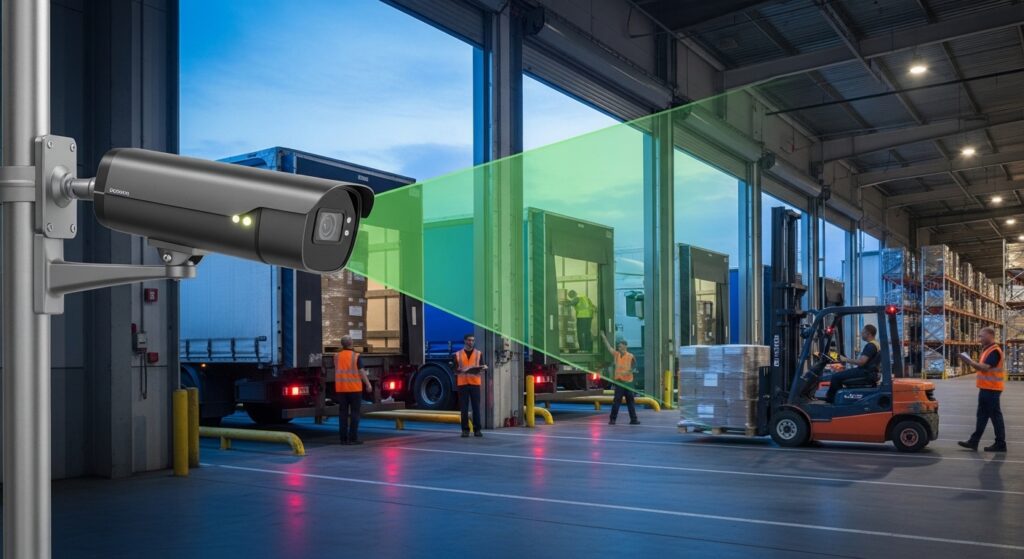
B) Loading docks
- Cover truck approach, docking, and cargo transfer point
- If plate capture matters, use a dedicated camera angle with consistent lighting
- Include coverage for barriers, gates, and handover points
C) Storage aisles
- Shelves create blind areas—plan for it
- Long corridor views can work, but height and lens choice matter
- Cameras placed too high reduce identification detail
- Avoid relying on one camera to cover multiple aisles
D) High-value zones
- Use higher detail coverage and stable lighting
- Cover the access path (who entered and who left)
- Add at least one overlapping view to reduce disputes
E) Emergency exits and perimeter
- Cover doors clearly, especially at night
- Perimeter cameras should be planned based on real darkness levels
- Make sure footage remains usable in low light (not just “bright noise”)
Common blind spot problems
(and quick fixes)
Blind spots don’t happen randomly. They usually come from the same layout mistakes.
Here are quick fixes that work.
Cameras are too high → Lower the angle or add a second camera for detail.
Corners and intersections are uncovered → Add corner cameras with overlapping views.
Backlight at gates/doors ruins the image → Change angle or add better lighting/shading.
Racks block key views → Add aisle-focused cameras instead of one wide camera.
Forklift traffic hides incidents → Add a wide context camera near traffic routes.
Lighting matters more than many people think
Lighting can make or break your CCTV footage. A good camera
with poor lighting still produces weak evidence.
- Avoid aiming cameras at bright doors/windows (strong contrast kills details)
- Plan for night lighting in docks, gates, and aisles
- Sometimes improving lighting gives a bigger result than upgrading the camera
Recording and retention
(don’t ignore this)
Many sites install cameras and forget the recording plan. Then, when an incident happens, footage is missing or overwritten.
- Decide how many days you need to keep footage (retention policy)
- Size storage based on camera count, resolution, and bitrate
- Add health monitoring to detect recording failures early
- Define who has access, and how footage is exported when needed
A simple checklist before finalizing the layout
Blind spots don’t happen randomly. They usually come from the same layout mistakes.
Here are quick fixes that work.
Cameras are too high → Lower the angle or add a second camera for detail.
Corners and intersections are uncovered → Add corner cameras with overlapping views.
Backlight at gates/doors ruins the image → Change angle or add better lighting/shading.
Racks block key views → Add aisle-focused cameras instead of one wide camera.
Forklift traffic hides incidents → Add a wide context camera near traffic routes.

Contact us